🎧Listen now on Spotify
Campus Comms Unplugged
Our podcast, Campus Comms Unplugged, hosted by Toby Roe, explores the challenges and opportunities shaping the future of marketing and communications in business education. We aim to overcome barriers faced by marketing communications professionals in business schools and help them make a bigger impact with their campaigns.
Each month, we feature insights from leaders in the field. We cover topics such as strategy, messaging, artificial intelligence (AI), international student trends, and more.
Episode 6
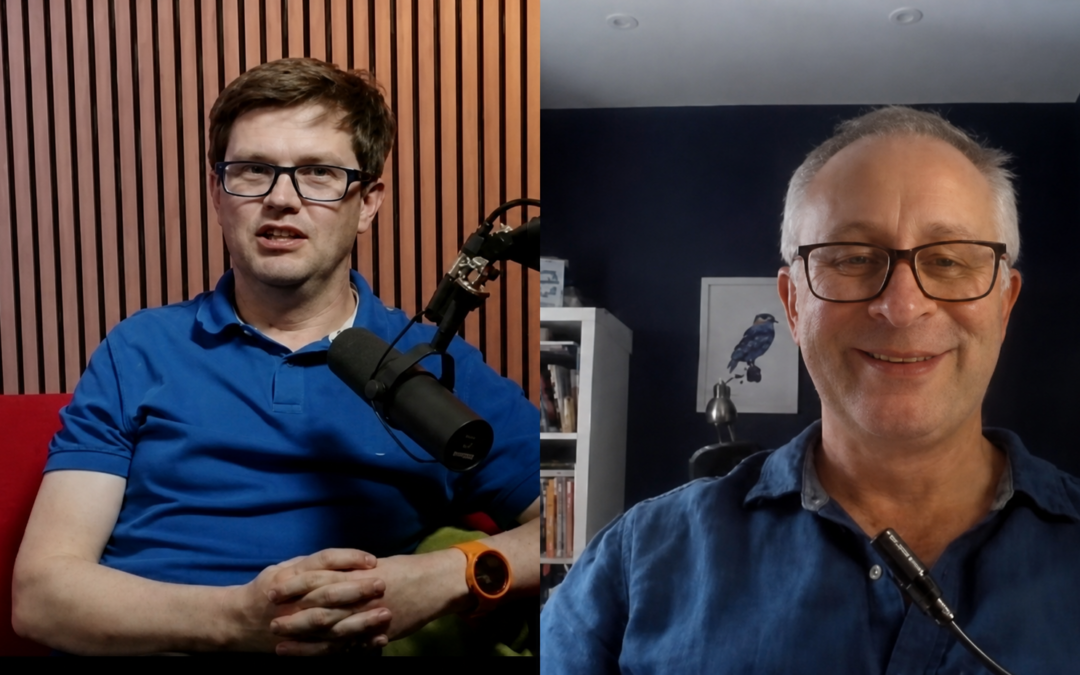
In our sixth episode, host Toby Roe sat down with Paul Turner from Lancaster University Management School. Paul is the Co-Host of the Transforming Tomorrow podcast from the university’s Pentland Centre for Sustainability in Business. The podcast has over 120 episodes and has a global audience.
Paul explained how he moved from journalism into business school communications and podcasting, bringing a practical, audience-first mindset with him. He explained how a podcast can support knowledge exchange, research visibility, and collaboration, especially when it serves a niche audience well.
Paul and Toby discussed the benefits of podcasting for business schools; the importance of a consistent theme; how to generate internal engagement; the key steps to building and retaining an audience; the platforms and podcasting equipment to use; the metrics to consider; and the dos and don’ts of launching a podcast.
Key takeaways
- The success of a podcast depends on having a clear purpose, a defined audience, and a plan beyond the first episode. Paul Turner advises planning for the long term, well beyond episode ten. Treat early recordings as pilot episodes, share them with people in your target audience and use their feedback to refine the format.
- Regular output matters. Many podcasts fail because they stop too early, so consistency is key to building momentum. Paul Turner notes that 25% of podcasts only publish one episode, and 90% never get beyond episode 10. His own show has run for more than 120 mostly weekly episodes, and that regularity is part of why it now feels “second nature”.
- For academic and business audiences, the content should stay accessible, conversational, and lightly humorous rather than overly formal or jargon-heavy. Don’t speak like an academic and avoid dense phraseology and acronyms that assume everyone knows the jargon. Aim for language that anyone interested in business can follow, and use humour and tangents so serious topics don’t feel like a formal lecture.
- Downloads are not the only measure of success. Reputation, partnerships, reading-list adoption, and real-world connections are better indicators. Focus on outcomes such as new research links, approaches from professional bodies, and episodes being added to university reading/listening lists.
- You do not need expensive equipment to start. A laptop and basic mic can be enough, although good production support helps as the show grows. You can record remotely with a standard computer kit and still make a strong podcast. Setup can evolve as facilities allow.
- The best podcasts feel human, enjoyable, and useful. It’s best if they are not overly self-serious or internally focused. Podcasts that sound like dull lectures lose listeners within minutes. It’s better to let personality and humour show through.
In their words
“I would say that internal expectations can be tricky, especially depending on who you’re speaking to. But if you’re building it as more like a reputation‑building exercise than a publicity mechanism – and there’s a differentiation there – it’s not just getting your name here, there and everywhere and getting hundreds of people listening. Still, it’s getting people to know what you are renowned for and building knowledge of you as an institution as being really good at a certain thing. I would say that’s it. Don’t get obsessed with numbers. Obviously, you want people to listen, but emphasise it as reputation‑building, as another avenue for getting your name out there and seeing what might come as a result of it.” – Paul Turner, Lancaster University Management School.
If you want to stay connected with the latest conversations on marketing and communications in business education, subscribe to Campus Comms Unplugged or CLICK HERE to sign up for our newsletter!